
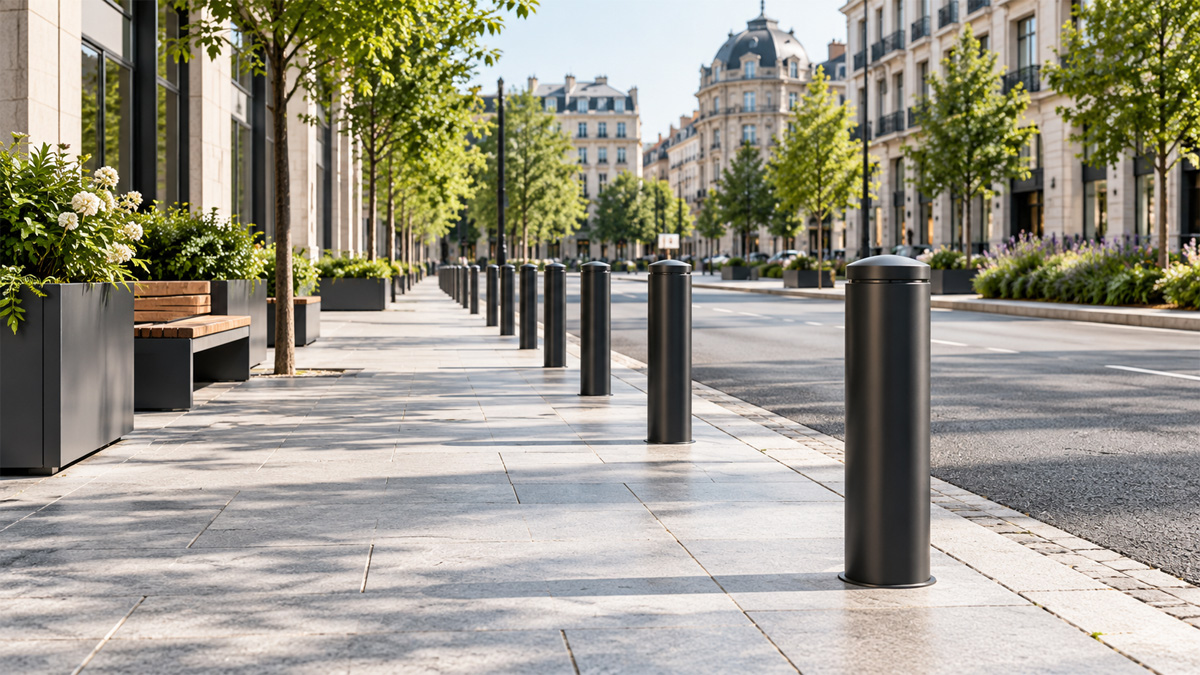
Street design is often judged by its most visible features, yet modest elements can have an equally important influence on how a place functions. Bollards are a clear example: when selected thoughtfully, they can organize movement, protect public space, and support greener urban environments without overwhelming the surrounding architecture.
Small Structures with a Broad Urban Role
At their simplest, bollards establish a physical boundary between areas intended for vehicles and those reserved for people. This distinction is increasingly valuable in city centers, residential developments, transport hubs, parks, and mixed-use districts, where several forms of mobility must coexist. A well-positioned barrier can discourage unauthorized access while preserving pedestrian routes, sightlines, and the overall sense of openness. Unlike fences or walls, these compact structures can define space without making it feel enclosed.
Their environmental value becomes clearer when they are considered as part of a wider planning strategy. Restricting unnecessary vehicle access may help protect planted areas, reduce damage to paving, and create calmer surroundings for walking and cycling. It can also make temporary pedestrian zones and outdoor community spaces easier to manage. Good urban design does not depend on one dramatic intervention; it often emerges from coordinated details that make streets safer, more legible, and more comfortable to use.
Matching the System to the Setting
Different locations require different levels of access control. Fixed models provide a permanent boundary and may suit pavements, landscaped zones, and sites where vehicles should never enter. Removable or manual options offer greater flexibility, while semi-automatic and automatic systems can regulate recurring access for residents, delivery vehicles, maintenance teams, or emergency services. A broad overview of available bollards shows how these categories respond to distinct operational and security needs rather than serving as interchangeable products.
The decision should begin with an understanding of daily activity. Planners need to consider how frequently access changes, who controls it, how much installation space is available, and whether electrical or hydraulic infrastructure is practical. In high-risk or sensitive areas, impact resistance and tested security performance may become central requirements. In quieter settings, ease of operation, maintenance demands, and visual compatibility may carry more weight. Context-led selection helps prevent both underestimating genuine risks and specifying unnecessarily complex equipment.
Designing for Durability and Visual Continuity
Functional performance is only part of the equation. Materials, finishes, proportions, and placement affect whether street furniture contributes to a coherent public realm or appears as an afterthought. Stainless steel can complement contemporary architecture, while painted or textured finishes may sit more naturally beside historic buildings, brick paving, or landscaped paths. Reflective details and integrated lighting can improve visibility, but they should be balanced against local character and the desire to limit excessive visual clutter.
Durability also has an environmental dimension. Products that tolerate weather, corrosion, repeated operation, and occasional impact are less likely to require premature replacement. Accessible foundations, replaceable components, and straightforward servicing can extend useful life while reducing material waste. For powered installations, reliable controls and efficient operating mechanisms may further support responsible resource use. Maintenance planning should therefore begin during design, not after installation, because long-term performance depends as much on accessibility and care as on initial construction quality.
Creating Streets That Adapt Over Time
Public spaces rarely remain static. Delivery patterns change, pedestrian areas expand, new cycling routes appear, and communities develop different expectations of their streets. Flexible access-control systems can help places respond without extensive reconstruction. Automatic units may allow a square to receive service vehicles in the morning and become pedestrian-only later in the day, while removable models can support occasional events or seasonal traffic arrangements. This adaptability gives local authorities and property managers more options as priorities evolve.
Ultimately, effective bollards should feel like an integrated part of the landscape rather than an obstacle added at the last moment. Their success lies in quietly guiding movement, protecting vulnerable areas, and supporting a more balanced relationship between vehicles and public life. When positioning, operation, appearance, and maintenance are considered together, these small structures can make a meaningful contribution to resilient, welcoming, and environmentally conscious urban design.